Showing posts with label b&w. Show all posts

Thursday, November 8, 2018

Goward Portal Tomb


Goward Portal Tomb is also known locally as Big Pat Kearney's stone.
The tombs massive capstone is without doubt the stand out feature of this must see site.

Said to weigh 50 ton this capstone has slipped and now rests on two taller stones.
The capstone is 4 meters long by 3 meters in width and over 1.5 meters in depth.

The tombs chamber is over 2.5 meters in length.

Goward is located in it's own neat enclosure and is the sort of site that makes you want to spend some time when you visit.

Access -  The tomb is just off the main Hilltown to Castlewellan road and has a couple of spots for parking close to the site.

Along with the other great tombs of County Down, Goward is not to be missed.      

Thursday, July 5, 2018

Kinneigh Round Tower


One of only two round towers to be found in County Cork is Kinneigh Round Tower.

The round tower is built on a large rocky outcrop, and has a unique 5 meter high hexagonal base.

The tower rises to a height of 20 meters and is round from the hexagonal section up.

The doorway is about 4 meters above the ground and faces North East.

Kinneigh Round Tower is estimated to have been built sometime between 900 and 1050.

To facilitate a bell an upper section was added in the mid 19th century.

The original  monastery in the area is said to have been founded by St Mocholmog in the year 619.

The site of the monastery was located 0.8 km to the West of the tower.

Access - The tower is located on the grounds of St Bartholomew's Church Of Ireland, in Kinneigh.

Parking can be found beside the graveyard.  This leaves you a short walk to the very striking tower.


Wednesday, May 2, 2018

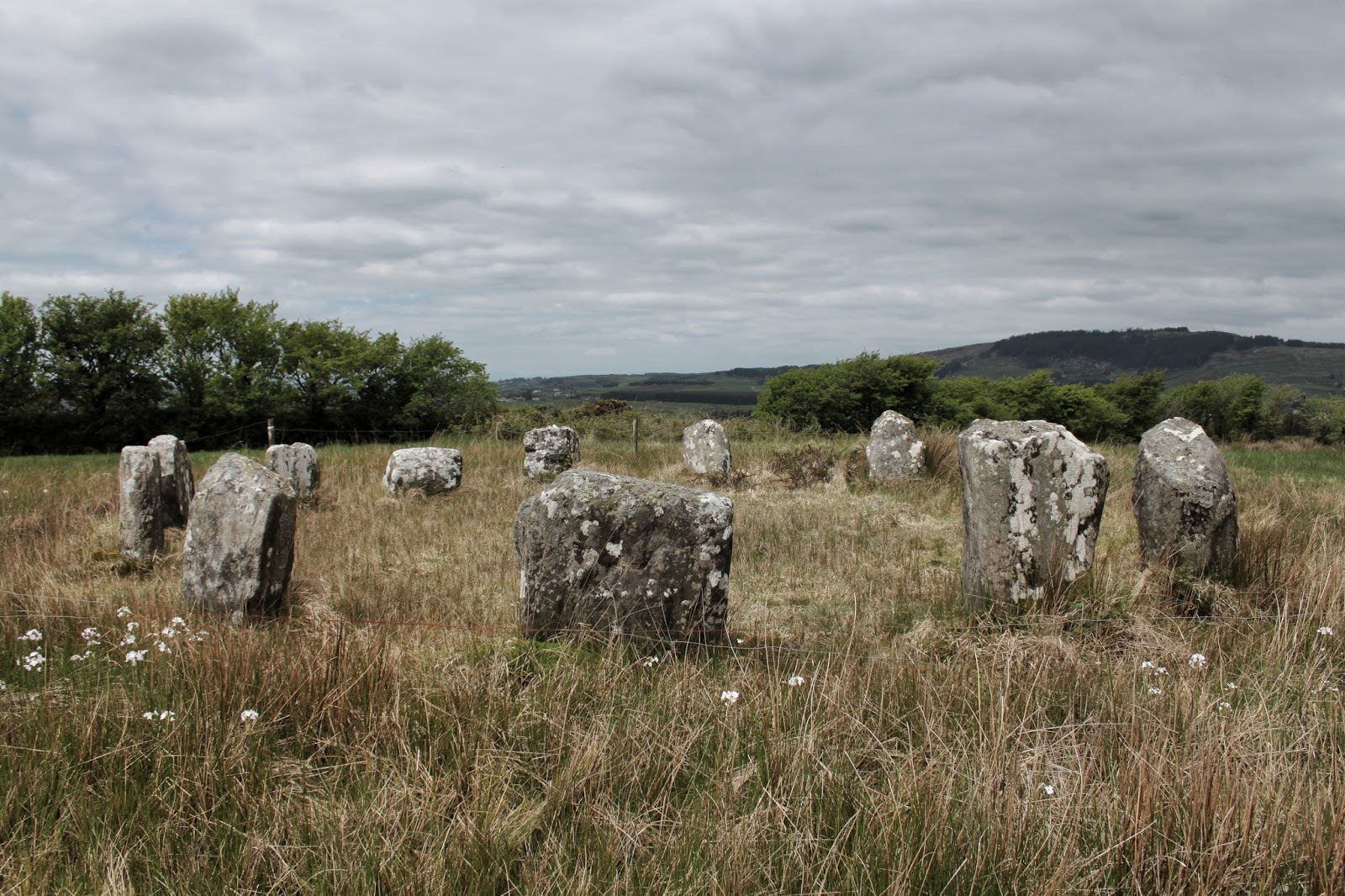
Ballyvackey Stone Circle


Ballyvackey Stone Circle is located in a plain low flat open pasture.

There are just seven stones left here from a probable original nine stones, although some believe there may have been as many as thirteen stones in the circle.

The remaining circles stones vary in height from 0.6m to 1.6 meter.

The circle is aligned ENE-WSW and the diameter of the circle 8.5 meters.   

There are much bigger and more famous sites located close by.
Despite being overgrown (I tried my best to stamp the growth down around the stones) don't be put off seeking this site as it will be well worth you time.
The circle even with the missing stones and somewhat plain location still has a nice presence about it.

Access - The site can be spotted from the main road. (R599)
It will be possible to park close to the circle (once one is careful).
Good footwear will be needed as the area close to the circle is quite marshy. 


Friday, September 29, 2017

Grangefertagh Round Tower


Grangefertagh Round Tower is the only remnant of an early monastery founded by St Ciaran of Seir. The original site is thought to date back to the 6th Century.

The site was raided by Vikings in 861 and in 1156 the High King Murtagh McNeale burned the tower.

The tower is 31 meters in height and that is with only a small part of the towers cap remaining.
The diameter of the tower is 4.8 meters.
Their are nine windows in total, six of which are angle headed & the remaining three are lintelled.

The doorway is 3.3 meters from ground level and as you can see in image 3 has had all of it's stone work removed.
This is said to have occurred when a farmer took the stones to help in the building of a fireplace!

The church is dated 13th Century and has had it's main section turned into a handball alley.

In one small section of the church is the tomb of Brian MacGiolla Phadraigh Lord of Ossory.

Access - The tower is very visible from the M8.
Parking can be found in a couple of spots close to the site. 


Monday, July 31, 2017

Ballybrit Castle


This is without doubt the most timely post I've ever done.

Starting this evening is the world famous Galway races.

Ballybrit Castle is located inside the racing circuit at Galway racecourse.

Not much is publicly known about the ruin.
What is know is that the castle is a de Burgo house.
Rectangular in shape the walls are said to be 1.5 meters in thickness.
The ruin rises to a height of 13.7 meters and is said to have a spiral like staircase inside.
Looking at the castle you are left in no doubt that this was a castle built to defend.

Access - As stated above the castle is on the grounds of Galway racecourse.
My visit was a working one over two separate days. 
 

Tuesday, June 27, 2017

Ferns Round Tower


Ferns round tower is a rare type of round tower to be found in Ireland but is not unique.
The majority of Ireland's towers are free standing but there are exceptions to this, examples can be found in such places as Glendalough (St Kevins)  and Killashee (Kildare).

The overall look of Ferns tower would also remind you of the free standing tower of Kinneigh which has a hexagonal base and gives way to the more traditional round section.

The tower here has a square base and rises to a height of over 18 meters.
The top of the tower has four square lintelled windows.  It also contains several defence slit openings.

The site of Ferns originally dates back to the 7th Century when it was founded by St Aiden.
Ferns was attacked by Vikings in the 9th and 10th Centuries.

The round tower is part of St Mary's Abbey which was founded by Diarmuid MacMurrough in the 12th Century.


The Ferns site also has a 13th Century cathedral and four high crosses one of which (only the base/shaft remaining) is said to mark the grave of  Diarmuid MacMurrough.

Access - parking can be found quite close to the site.
The tower can be accessed via the cathedral (to the left of the tower image no 2). 


Tuesday, May 30, 2017

Reanascreena Stone Circle


The superb stone circle of Reanascreena had been on my wish list of sites to visit ever since seeing images of the circle on the great Megalithic Ireland web site.

The Circle has twelve stones which are all over one meter in height.
The two portal stones (image 2 on the right) are slightly higher than the circles other stones.
The circle is aligned ENE-WSW and the circle has a diameter of just over 9 meters.

A feature I did not see on the day of my visit was the quartz stone in the middle of the circle. 

The circle has fencing quite close to the stones (which makes getting close ups of the stones impossible) this may be to protect the stones as Horses are sometimes kept in the sites field.

Reanascreena is truly a special site.
My visit was a bit rushed due to work but I would hope to make a return visit sometime in the future.

The site was excavated from 1959-69 by Fahy.

Access - The circle is not visible from the road.
I spoke to a farmer who gave me the directions.
Enter the first field via the gate to the right of the bungalow, walk up the field to the top of the hill and the circle is in the next field on your left.   


Friday, April 28, 2017

Bruree Castle (aka Ballynoe)


The ivy covered ruin of Bruree Castle can be found in the beautifully kept Ballynoe graveyard.

The ruin according to a badly damaged plaque at the entrance to the graveyard states the castle is also know as Ballynoe Castle.  

The castle would also appear to be referred to occasionally as the higher castle as it is built on high ground overlooking the village of Bruree - with the Maigue River flowing just below it and there are some other castle's situated close by on lower ground once owned by the De Lacy's.

Bruree castle is dated to the 14th Century (the claim that the Knights Templars built this castle in the 12th century is unsupported).

Cromwell's troops took the castle in the 15th Century and apart from that not much else is known about the history of the castle.
Indeed if you put Ballynoe Castle into a search engine you will find out about a champion show jumping horse with an unusual condition.     

Today the ruin has fencing protecting the open lower part of the castle (image 5) which prevents the ruin from being further explored.

Access - The castle is very visible as you enter Bruree.  
Parking can be found in the lane way that brings you up the graveyard. 


Friday, March 31, 2017

Drumbo Round Tower


Drumbo Round Tower is all that remains of an early Christian site, which originally dated back to the times of St Patrick.  

The tower rises to a height of just over 10.6 meters.  The doorway is 1.5 meters from ground level (which is very low for a round towers doorway).

Inside the tower, beam holes are visible indicating that the towers floors were of timber.

Records show the tower was severely damaged in the 11th Century.

Restoration work has been carried out on the tower with the top rebuilt in the 18th Century.

Access - The tower can be found within the grounds of the local Presbyterian church.
Parking can be found within a short walk to the graveyard and tower.


Wednesday, January 18, 2017

Kilmallock Round Tower


This much altered round tower is all that remains from an earlier site that dates back to the
7th Century Monastery built by St Mocheallog.

The round tower is dated sometime between the 10th and 11th Century and has now the later west wall of the church built around it.

The towers original stone work can be best viewed from outside the church at the base (image 2).

From a couple of meters up the tower changes in masonry and appearance, with the medieval work carried out on the tower becoming more obvious the higher you go.

The round tower of Kilmallock has been much altered and as a result is very different from other towers to be found in Ireland.

The Collegiate Church which is dedicated to St Peter and St Paul was built in the 13th Century.

As I was stuck for time on the day of my visit and was intent on making the tower shots a priority I did not get to explore the church or any of the other great sites in Kilmallock.

Access - The tower is located just off the main street in Kilmallock, the streets are narrow but parking can be found without great difficulty.     


Tuesday, December 6, 2016

Srah Castle


The striking but dangerous ruin of Srah Castle can be found a short walk from Tullamore town along the Grand Canal.

Built in 1588 by John Briscoe (an Elizabethan officer from Cumberland).

The four storey tower is 20 meters high and has the ruin of a 17th Century house attached on the NW corner.

Some of the features of this ruin are a Bartizan, gun loops and a Machicolation (which was used for dropping rocks and boiling liquids on attackers of the castle) Image 6 shows these features.

Despite being well fortified the castle was badly damaged in 1650 in the Cromwell campaigns.

The inside of the ruin has a broken spiral staircase (image 3) this may have been broken recently on safety grounds.

Access - The castle can be spotted as you walk along the canal, an easy enough fence to climb brings you into the field where the ruin is.