Showing posts with label galway. Show all posts

Monday, July 31, 2017

Ballybrit Castle


This is without doubt the most timely post I've ever done.

Starting this evening is the world famous Galway races.

Ballybrit Castle is located inside the racing circuit at Galway racecourse.

Not much is publicly known about the ruin.
What is know is that the castle is a de Burgo house.
Rectangular in shape the walls are said to be 1.5 meters in thickness.
The ruin rises to a height of 13.7 meters and is said to have a spiral like staircase inside.
Looking at the castle you are left in no doubt that this was a castle built to defend.

Access - As stated above the castle is on the grounds of Galway racecourse.
My visit was a working one over two separate days. 
 

Thursday, August 4, 2016

Claregalway Friary


The vast ruin of Clairegalway Friary stands overlooking the river Claire as you leave the village of Clairegalway travelling north on the N17.

The Friary dates back to the 13th Century and was built by John de Cogan.
The Franciscan community lived under the patronage of the de Cogan clan until 1327, when
de Cogan gave them the building and surrounding lands.

The following years saw the friary flourish in numbers and wealth.

The ruined state of the friary is mostly a result of two major happenings in the 16th Century.
In 1538 Henry VIII sent Lord Leonard Gray to Galway.
It is recorded that the friary at Claregalway was rifled by Gray’s troops on their way to Galway.
In 1589 Sir Richard Bingham, the English governor of Connaught,  cleared the friary and used the building as a barracks.

By 1641 the Franciscans had returned to the friary.
A failed attempt was made to rebuild.
From then on their numbers declined so that by 1838 the friary was down to two members.    

In 1892 Lord Clanmorris donated the property to the Commissioner of Public Works

The Franciscan friary consists of a nave,choir, north aisle and transept. 
The square bell tower is the most striking feature of the friary and is dated to the 15th Century.
It is 24 meters in height.
All other parts that survive today of the structure were built in phases during the friary's time of prosperity.

Access - The friary can be spotted from the main road (on your left) as you leave Claregalway heading north on the N17.
Parking can be found in the car park which is right beside the graveyard and ruin. 


Tuesday, May 10, 2016

Cloughanover Castle


The history of Cloughanover Castle is pretty much a mystery.
The couple of scraps of information I have found are below.


What is known is that the castle was built as a stronghold by the Anglo-Norman de Burgo family in 1450.

It is claimed that Cloughanover Castle was destroyed by Cromwellian forces in the 17th century.

Not very much remains today, but the fireplace and entrance to the castle latrines/toilets can be seen clearly in (image 3).

Access - The ruin is visable on the right coming from Galway heading towards Headford on the N84.
Take a right turn before the petrol station.  This will bring you to Cambells Tavern in Cloughanover
Cloughanover Castle is just across a couple of fields from Cambells Tavern.


Thursday, May 7, 2015

Kilbennan Round Tower


Kilbennan is said to have been the site of a 5th Century monastery. 
The old monastery was founded by St. Benan or Benignus, St. Patrick's successor at Armagh.

The very eye catching tower is dated to the 10th Century and is built from rough coursed limestone. 
Strangely no mention of the tower is made in the records of the burning of the site in 1114.
The tower at it's highest point is over 16 meters in height, the base is close to 5 meters in diameter.
The doorway is over 4 meters from ground level and is plain in it's design.
This tower always brings a smile to my face, as my daughter pointed out on my latest visit "the tower looks like Pacman took a bite out of it".

The church is dated to the 14th Century when the Franciscans founded a monastery on the site.

Access - The tower is visible from the R332 Tuam Ballinrobe road, parking can be found opposite the site in the more modern church car park. 


Wednesday, March 25, 2015

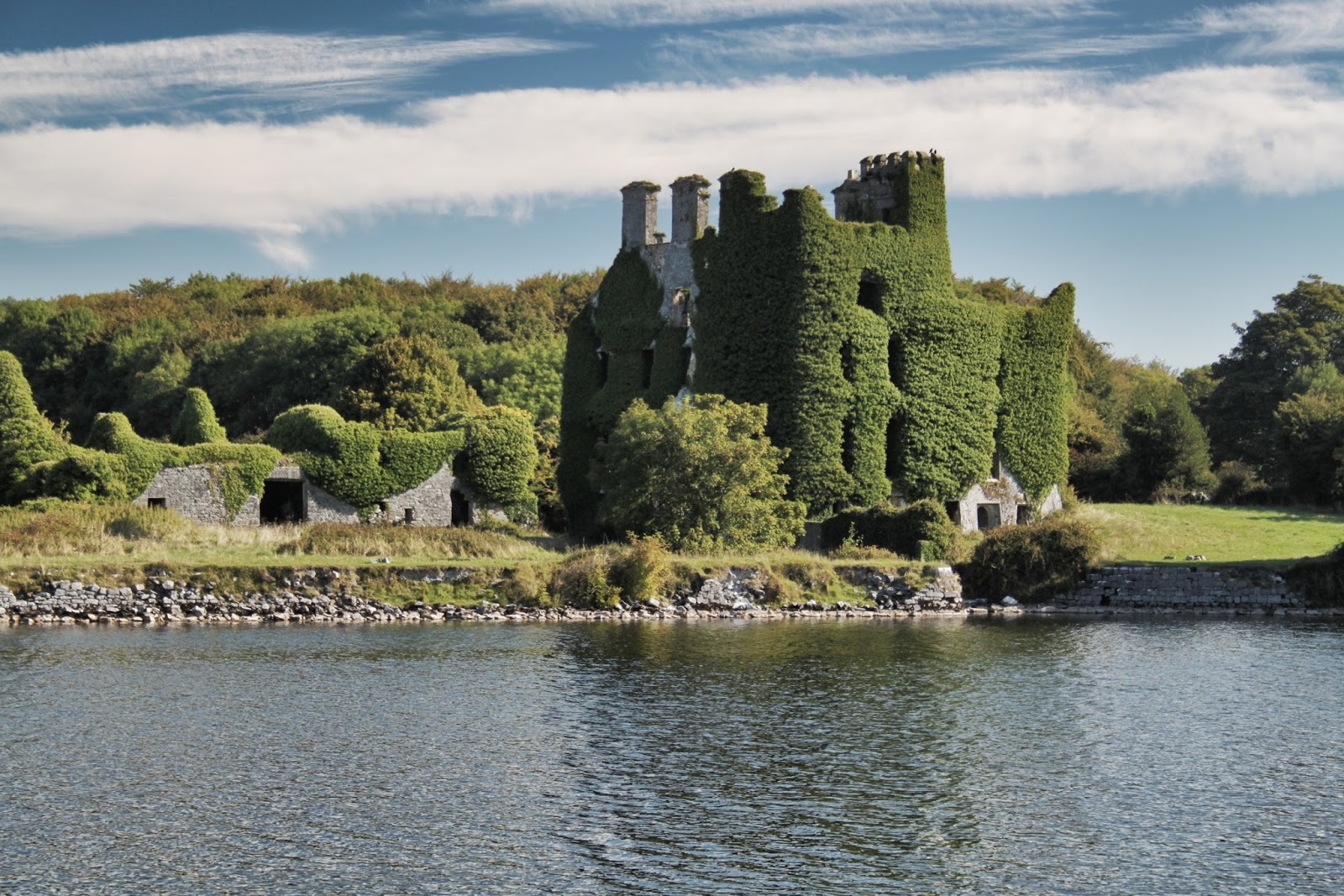
Menlo Castle


Menlo Castle dated 15thCentury is a vast ruin that is located on the bank's of the River Corrib.
The Castle was built in 1569 and was the main home of the Blake family.
The Blake family were one of the famous Tribes of Galway. 

The Blake's remained at Menlo until 1910 when the castle accidentally and tragically burned down.
Killed in the fire was Eleanor Blake the only daughter of  Lord Valentine Blake.

As a result of the fire the castle was totally gutted and what you see today is all that was left.
The wall's of the ruin are mostly covered in ivy, with some of the opinion that it is this very ivy that holds Menlo together.

Access - The turn for the castle is just before Terryland as you travel on the N84 heading towards Galway.
From the main road you are left a short drive to the old entrance (bottom image).
Parking for a couple of cars can be had close to the cattle gate and leaves you with a short walk down to the castle.

To view the castle from the far side of the River Corrib turn off the N59 for the National University of Galway.         


Monday, February 23, 2015

Oranmore Castle


Oranmore Castle, County Galway is dated to the 15th Century but is thought to have been built on the site of an earlier castle.
The castle was a stronghold of the Clanricardes, a prominent Norman family in Galway.  

The castle under the lordship of the fifth Earl Clanricardes played a major role in the Confederate Rebellion in the 1640's.
Oranmore was surrendered in 1643 by Captain Willoughby.
This was done without the knowledge or permission of the Marquess.
In 1651 the castle was surrendered to the Parliamentary forces.

The successor of the Marquess the 6th Earl regained the castle and in 1666 he leased Oranmore to Walter Athy.
Oranmore through marriage passed to the Blake family of Mayo.
The castle stayed in the care of the Blake's  until 1853 when it was abandoned.

Oranmore was purchased in 1947 by Lady Leslie, and the castle has remained in her family's care to date.

Access - The castle is well signposted from the main street in Oranmore.
As the castle dominates the coastline you won't need any help.
Oranmore can be visited at times during the summer.
Booking ahead would be advisable as the castle amongst other things is considered to be haunted.   


Friday, January 16, 2015

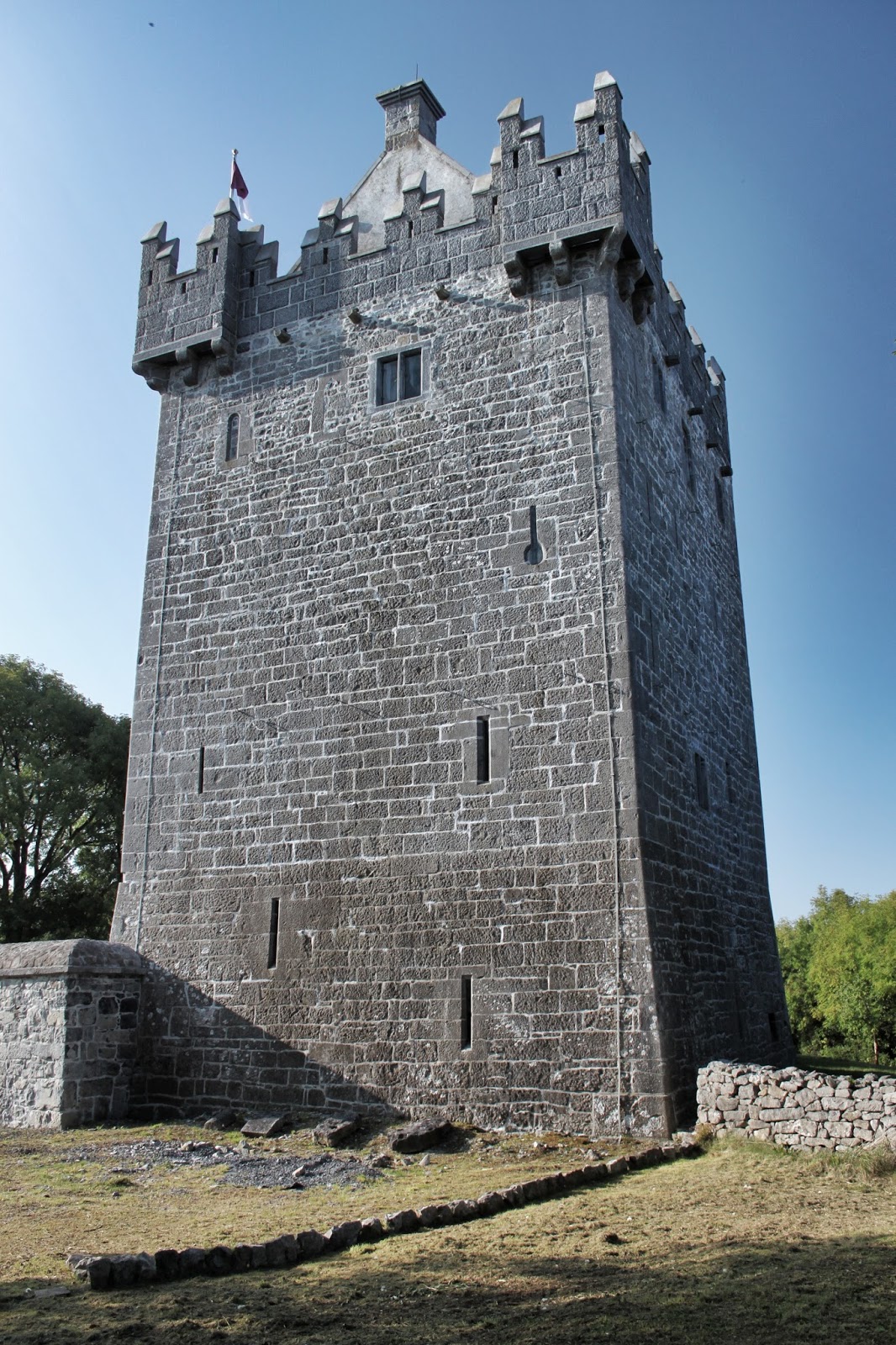
Annaghdown Castle


The recently restored castle of Annaghdown can be found on the eastern shore of Lough Corrib.

The castle is said to date back to the 14th Century and is thought to have been built by the O'Flaherty clan, or depending where you read it may have been the Archbishop of Tuam in 1421.

When built the castle was used to control lake traffic to and from Galway city as roadways were not built until much later.

The original castle is said to have been five stories high with a murder hole.
What you see today looks to be four stories high.

Ray Cook of Galway bought the castle from Lady Cusack-Smith for £2.000 in the 1970's.
What can be seen today is the result of the restoration carried out by Ray and family in a later style than the original castle.

Access - The castle is a short drive from Corrandulla.
You will be able to see the site peeping above a line of tree's as you near the village of Annaghdown.
The castle is on private land, so please make sure to ask for permission to visit the site.  


Thursday, November 6, 2014

Anbally Castle


The ruin of Anbally Castle County Galway is dated to the 15th Century.
The name translates from An-bhaile meaning "great town".
The Burke family name is the most associated with Anbally from the time of being built and for a considerable time after.
The castle was at some stage in the past called Tavenagh Castle.
 
The castle has a vaulted ceiling and the remains of a spiral staircase.

Access - The castle is located a short drive from the N17, you will have to cross a couple of fields to get up close to the ruin.
Visiting the castle in the summer months is recommend as the surrounding land is prone to flooding in the winter from the nearby Turlough river.


Thursday, September 25, 2014

Cloonboo Castle


Cloonboo Castle can be found in the parish of Annaghdown.
The castle is said to have been one of many built by the Skerrett family in the local area.
The town land that Cloonboo stands in is called Castle quarter (which seems pretty appropriate).

The castle (thought to be 15th Century) is four stories high and has a partial spiral staircase on the mostly ivy covered north side.
This side also has a entrance to the castle ( where signs are located warning you to stay out of the dangerous ruin).
While I stood at the doorway looking inside the castle a horse walked in by me, it would seem the castle now acts as a stable for the two horses in the field that surrounds the castle.

Access - The castle can be seen from the N84 Headford to Galway road.
Parking is not a problem. You can park quite close to the castle - at the entrance to Abbey Signs buisness.


Friday, September 19, 2014

Kilcoona Round Tower


Kilcoona derives it's name from the saint Cuana who founded a monastery on this site in the 7th Century.
Saint Cuana is noted as one of the ancient Irish writers.  "The Annals Of Cuana" are attributed to him.

The round tower is dated from the 12th Century.
The tower is 3 meters high.
The most striking feature of the tower are the massive blocks of dressed limestone.
Some of these stones have been cut into each other.
The tower as you find it today is half overgrown and nearly filled to the tip with rubble.

Access - The tower is located in the beautiful kept graveyard of Kilcoona village.
Parking is not a problem.
Galway has bigger and more famous towers but Kilcoona is well worth seeing for the unusual stonework and well kept graveyard.


Friday, September 5, 2014

Barnaderg Castle


The name Barnaderg comes from the Irish Bearna Dhearg meaning "red gap"
The castle dates back to the 16thCentury and is claimed to have been one of the last castles built in Ireland.
Built by Malachy O'Kelly, Barnaderg and the surrounding areas were known to be a stronghold of the O'Kelly clan.

The castle is said at one time to have had a draw bridge, seeing how saturated the land around the ruin can be most of the year it is pretty easy to visualize how this would have looked.

Access - The castle is located just outside the village of Barnaderg on the R332, parking can be found roadside.
Apart from the mostly flooded fields, cattle would seem to be a regular feature in and around the site.