Friday, December 5, 2014

Kilmacduagh Monastery

St Colman's Church (Templebeg MacDuagh)


The Cathedral (Templemore Mac Duagh)
The Church of St John the Baptist (Teampuill Owen)
Teampuill Owen and Glebe House

St Mary's Church (Temple Mary)

The O'Heyne's Church

The stunning Kilmacduagh monastery was founded by St Colman in the 7thCentury.

Famed as the tallest round tower in Ireland Kilmacduagh is 34 meters in height with the doorway set 7 meters above ground level.
The walls at the base are said to be just under 2 meters in thickness. 
The tower is dated from the 12th Centurty. 
The tower has quite a visible lean to it - said to be 0.5 meter from the vertical.

The biggest church building on the site is the cathedral ( Templemore Mac Duagh). dated between the 11th and 12th Century. Not having too much time and the fact the gate into the the cathedral was locked I was unable to get a close up of the interior.

The Church of St John the Baptist (Teampuill Owen) is in the field next to cathedral.  
It dates from the 10th Century which would make this church the oldest building on the site.

The Glebe House is in the same field as Teampuill Owen. 
Dated the 14th Century it is thought to have been the Abbots living quarters.
The building has a real fortified look to it. 
For closer inspection a key can be obtained from a local B&B to visit the inside.

The building in the foreground of the lead image is St Colman's church (Templebeg MacDuagh). 
Information is pretty hard to come by about this church.
To be honest only that I was looking for something a bit different for the tower shot I don't think I would have come across this church.

St Mary's church (Temple Mary)13th Century is divided from the rest of the site by a road. 
For those with more time a key can be got from the above mentioned local B&B to explore more.

Located at the furthest point from the round tower is The O'Heyne's Church 13th Century. 
Again this church was locked up on the day of my visit but looks to have some very nice features inside.

Access - Kilmacduagh is a short drive from Gort, Co Galway.  
The site is signposted with plenty of parking available. 
You will see the site from a long way off due to the round tower.  


Thursday, November 27, 2014

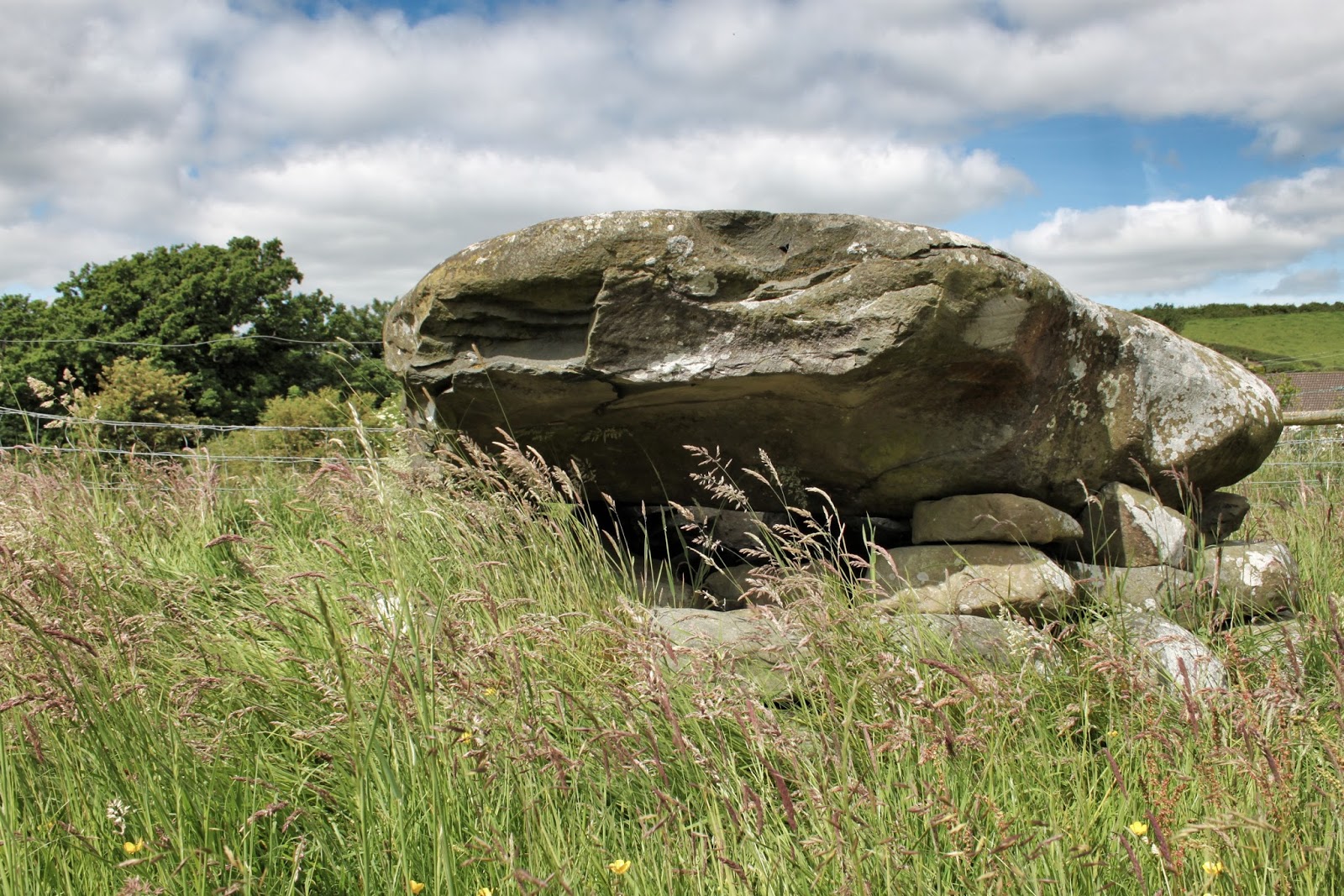
Annadorn Dolmen


The romantic in me would prefer to call Annadorn a portal tomb.
This is said as the evidence of what the site was would seem to make a better case for Annadorn originally being a passage tomb. There is a written account of a visit in 1802 that states that the site of Annadorn formerly sat beneath a large rectangular cairn over 18 meters in diameter and was approached by a lintelled passage.

What you can see today is a large impressive cap that sits on a rectangular chamber of many small stones with three large side stones that can clearly seen (even when the grass is overgrown).

Annadorn (which is signposted) is located a short drive from the A2 road.
Although the sites enclosure is on a bad bend on the road, parking can be found quite close leaving you a with a small climb up the steps to the site.


Thursday, November 20, 2014

Old Mellifont Abbey


Old Mellifont Abbey was the first Cistercian monastery founded in Ireland.
St Malachy brought the European monastic lifestyle to Ireland in 1142.

Such was the power of Mellifont, that many of the monks who started out in Mellifont went on to form many other cistercian monasteries in Ireland. More than 20 such abbeys were built during this period.

Mellifont despite some problems mainly flourished, this was mostly because of its size and the surrounding fertile land

In 1539 Mellifont became one of the first monasteries to be dissolved by Henry VIII.  Much of the abbeys brickwork was then used in the building of a fortified house.                

William of Orange used Mellifont as a headquarters during The Battle of the Boyne in 1690.

By the 18th century Mellifont lay in ruin having long since been abandoned.

Taking a walk around the perimeter of what is left of the abbey it is not hard to imagine the many monks (upwards of 100) that were housed in this vast site.

The stand out feature of the site is the 13th century octagonal Lavabo.
This was used by the monks to wash their hands before prayer.
To the left of the Lavabo in image No 4  is a 14th century chapter house (this was closed on the day of my visit).                                                     
The site also has a gateway close to the main entrance.  Due to the time of year of my visit I was unable to access the field its in because of  marshy/boggy conditions

The visitors centre is open May to October, which is probably the best time to visit and not November as yours truly did.


Thursday, November 13, 2014

Knockraheen Stone Circle


The superb site of Knockraheen boasts a circle, stone row and a radial cairn.
The main purpose of my visit was to see the stone circle.

Knockraheen is a lovely five stone circle.
This was my second visit to the site and as on my first visit the site is still in need of a clean up.

The circle has a diameter of 3.8 meters.
The low and long axial stone is over 1 meter in length and over 0.5 of a meter in height, this stone faces S/W.
The four other stones of the circle vary in height and are close to the 1 meter mark.

The two standing quartzite stones are both over the 1 meter mark.
You will pass these stones as you walk to the circle from the road.

The radial cairn was so badly overgrown on the day of my visit I did not attempt to photograph it.

Access - The road that runs beside the site is very narrow so parking is tricky, but you will be able to see the circle from the road.
This really is a great little site, and if it got a little bit of clean up it would be pretty close to perfect.  


Thursday, November 6, 2014

Anbally Castle


The ruin of Anbally Castle County Galway is dated to the 15th Century.
The name translates from An-bhaile meaning "great town".
The Burke family name is the most associated with Anbally from the time of being built and for a considerable time after.
The castle was at some stage in the past called Tavenagh Castle.
 
The castle has a vaulted ceiling and the remains of a spiral staircase.

Access - The castle is located a short drive from the N17, you will have to cross a couple of fields to get up close to the ruin.
Visiting the castle in the summer months is recommend as the surrounding land is prone to flooding in the winter from the nearby Turlough river.


Thursday, October 23, 2014

Kilkeel Portal Tomb (The Crawtree Stone)


Ever since seeing Kilkeel Portal Tomb on Jim Dempsey's great web site Megalithic Ireland it has been on my wish list. So making a slight detour on my way to work last week brought me to Kilkeel and this tomb did not disappoint.

The tomb as you first see it from the lane way looks like it is trying to escape and has got stuck on the banked wall.

The capstone is an impressive 2.5 meters in width and over 0.5 of a meter in depth.
The two portal stones are 1.3 meters in height and just under 1 meter in width.
The side slab stones are 1.5 meters in height and over 1 meter in length.

The stone at the front of the tomb and the newish looking boulder at the back do not belong to the original tomb.

Access - The tomb is just off the main street in Kilkeel, park in the Asda car park and walk up the lane way you will see the back of the tomb on your left.  


Wednesday, October 15, 2014

Loher Stone Fort


Loher Stone Fort unlike the nearby Staigue Stone Fort is in fact an early Christian defended farmstead.
What you see today is the result of a recent reconstruction that when being carried out found the remains of farm buildings made of wood and later of stone.

In the interior circular house a souterrian entrance was found. This would have been used to hide when under attack and as a place for cool storage of foods.
The souterrian has been closed up since the restoration.

The walls are close to 3 meters in height and can be climbed from the interior via crossed stairways.
Unlike Staigue walking on top of the wall's is not a problem (once you have the head for height's).

Access - Loher is just a short drive from the N70 and is well signposted.
Parking is available for six or seven cars, unless someone goes sideways !
From there you are left with a short walk to the immaculately kept ground around and inside Loher.     
The views from Loher are nothing short of superb.
Mountains surround Loher on three sides with the fourth side giving you a great view of Ballinskelligs Bay where on a clear day you can see Skellig Michael in the distance.