Tuesday, June 2, 2015
Kells Round Tower
This site is associated with St Columba (also called St Colmcille).
In 806 AD Irish monks from St Columcille’s monastery in Iona Scotland settled in Kells.
The tower is dated to the late 10th early 11th Century and is 26 meters in height.
The tower has a total of 9 windows with the bell storey accounting for 5 of the windows.
The other 4 windows are on what would have been the different floor levels of the tower.
The graveyard of St. Columba's Church has been built up on the side of the towers doorway, but if you take your measure from the road side of the tower it would place the doorway 3.6 meters from the base.
The graveyard also has four high crosses including the unfinished cross in the top image.
I hope to cover all the crosses in Kells in a future post, this will include the relocated Market Cross.
Access - The tower is very visible from the outskirts of the town.
Pay parking can be got right beside the tower.
The entrance to the graveyard is a short walk from the tower.
Monday, May 18, 2015
Clogherane Stone Row
Clogherane Stone Row really could not be in a better setting.
The two stones are situated on a flat rise over looking the bay of Kenmare with striking mountains/hills acting as a backdrop.
The stone row is aligned NNE - SSW.
The larger of the two stones is 2.6 meters in height and 1.5 meters in width at it's widest point.
The smaller stone is over 1 meter in height and just over 0.5 of a meter in width.
This site (and many others that I hope to be posting in the future) I came across as a result of Michael Mitchell's superb Blog Walking to the stones.From Dartmoor to County Cork .
Access - The stones are in a field that would appear to have sheep as company the majority of the time.
If you park in front of the house, on the right hand side the lane way will bring you to the stones behind the house.
Make sure not to block the lane way.
Labels:
b&w,
clogherane,
clogherane stone pair,
clogherane stone row,
colour,
healy pass,
historic sites of ireland,
ireland,
kerry,
megalithic,
munster
Location:
Clogherane, Co. Kerry, Ireland
Thursday, May 7, 2015
Kilbennan Round Tower
Kilbennan is said to have been the site of a 5th Century monastery.
The old monastery was founded by St. Benan or Benignus, St. Patrick's successor at Armagh.
The very eye catching tower is dated to the 10th Century and is built from rough coursed limestone.
Strangely no mention of the tower is made in the records of the burning of the site in 1114.
The tower at it's highest point is over 16 meters in height, the base is close to 5 meters in diameter.
The doorway is over 4 meters from ground level and is plain in it's design.
This tower always brings a smile to my face, as my daughter pointed out on my latest visit "the tower looks like Pacman took a bite out of it".
The church is dated to the 14th Century when the Franciscans founded a monastery on the site.
Access - The tower is visible from the R332 Tuam Ballinrobe road, parking can be found opposite the site in the more modern church car park.
Friday, April 24, 2015
Roodstown Castle
Roodstown Castle (15th Century) is a fine example of the many tower houses built in Leinster between the 14th and15th Century.
The castle is four stories high and is roofless.
Two of the square turrets are projecting from the castle.
One of these turrets contains garderobes (toilets), the other has a spiral staircase giving access to the different floor levels and the battlements.
The first and second floor have finely carved windows (15th Century) image No 2 .
The ground floor is vaulted and just inside the entrance is a murder hole.
This was my third visit to Roodstown and as on previous visits the castle was locked up, I have read somewhere that a local maybe is the key holder.
Access - The castle can be found a short drive from the M1, I parked close to the farm opposite the castle so as not to block the narrow road.
.
Thursday, April 9, 2015
Dromiskin Round Tower High Cross and Church
Dromiskin Monastery was founded by Lughaidh a disciple of St Patrick.
The monastery came under attack in 908 from the Irish, the Danes in 978 and again by the Irish in 1043.
The tower is over 15 meters high as a result of the tower being used as a belfry and then recapped.
This has now left the tower with a shrunken look to it.
When viewed from the front this tower always makes me smile.
The Romanesque doorway (missing some stone work) is just under 4 meters from ground level.
The head of the high cross dates back to the 10th Century- it was grafted onto a granite shaft and base in 1918.
The church ruin dates to the 12th Century with the window dated to the 15th Century.
The more modern St Ronan's Church of Ireland was built in 1821.
It is now in a dangerous derelict state.
The village of Dromiskin is a short drive from the M1.
When you arrive at the village you will have no problem spotting the tower.
Parking is available right outside the gate of the graveyard.
Labels:
b&w,
church ruin,
colour,
dromiskin round tower,
graveyard,
high cross,
historic sites of ireland,
ireland,
leinster,
louth
Location:
Dromiskin, Co. Louth, Ireland
Wednesday, March 25, 2015
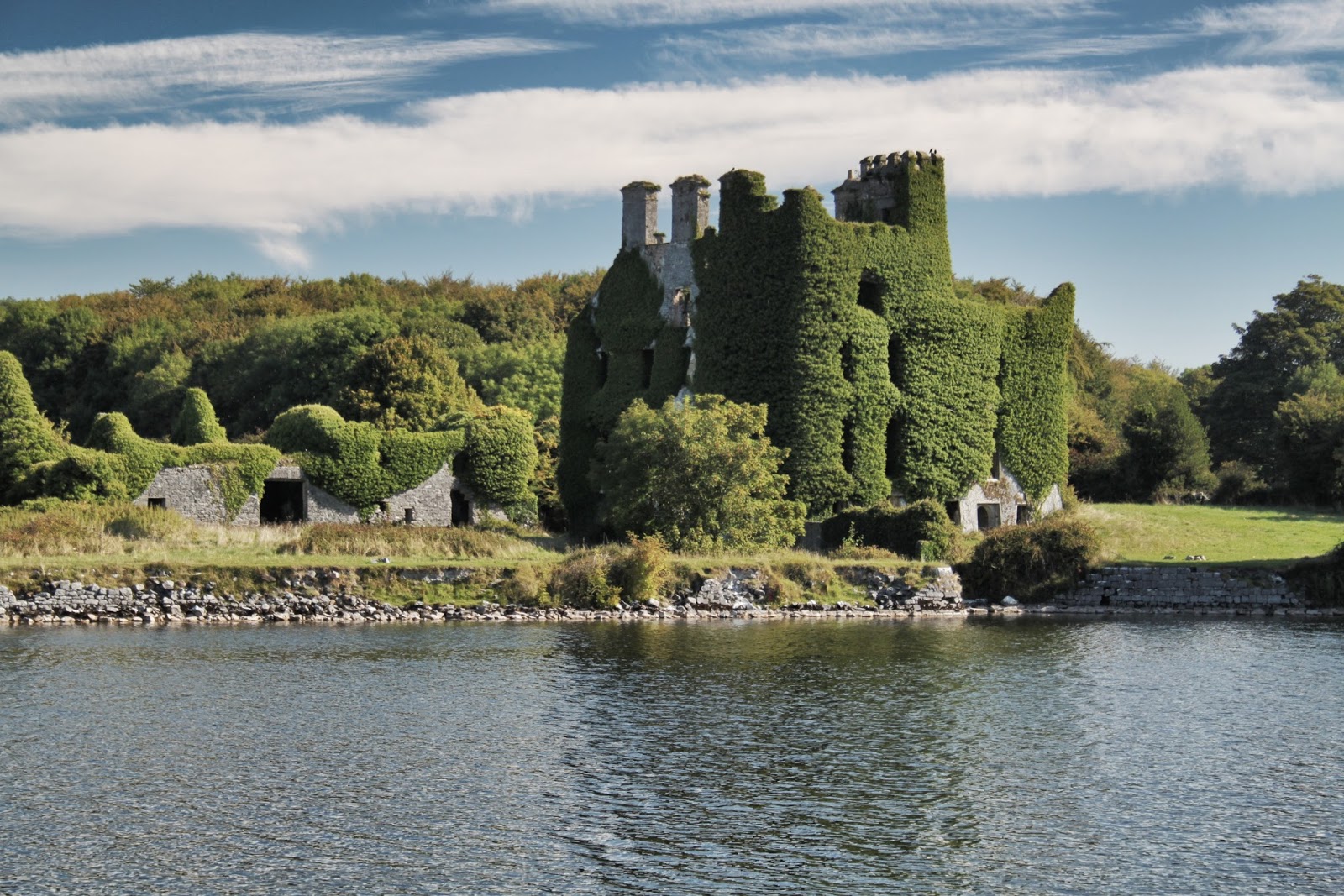
Menlo Castle
Menlo Castle dated 15thCentury is a vast ruin that is located on the bank's of the River Corrib.
The Castle was built in 1569 and was the main home of the Blake family.
The Blake family were one of the famous Tribes of Galway.
The Blake's remained at Menlo until 1910 when the castle accidentally and tragically burned down.
Killed in the fire was Eleanor Blake the only daughter of Lord Valentine Blake.
As a result of the fire the castle was totally gutted and what you see today is all that was left.
The wall's of the ruin are mostly covered in ivy, with some of the opinion that it is this very ivy that holds Menlo together.
Access - The turn for the castle is just before Terryland as you travel on the N84 heading towards Galway.
From the main road you are left a short drive to the old entrance (bottom image).
Parking for a couple of cars can be had close to the cattle gate and leaves you with a short walk down to the castle.
To view the castle from the far side of the River Corrib turn off the N59 for the National University of Galway.
Labels:
b&w,
blakes,
colour,
connacht,
corrib,
fire,
galway,
historic sites of ireland,
ireland,
ivy,
menlo,
menlo castle,
ruin
Location:
Galway City, Co. Galway, Ireland
Tuesday, March 10, 2015
The Hill Of Slane
The impressive site of The Hill Of Slane stands 158 meters above the surrounding area.
As it is such a large site it is possible to be seen well in advance when travelling on the N2 to Slane from Dublin.
It is claimed (but disputed) that St Patrick lit a paschal fire on it's summit in 433 AD while a festival was being celebrated on the nearby Hill Of Tara. This was in defiance of the High King Laoire whose pagan beliefs were that no other fires should be lit during pagan festivals.
What you can see today is mostly dated from the 15th Century.
It is said to have been built on a earlier site.
The 19 meter high Gothic tower (image no 2) was founded along with the Franciscan friary and the collage (image no 3) by Sir Christopher Fleming in 1512.
Access - The site is signposted on your left as you leave Slane heading towards Collon.
Parking is not a problem as their is a good size clearing (you are warned not to leave valuables visible as cars have been broken into).
From the car park you are left a short up hill walk to the site.
Subscribe to:
Comments (Atom)